
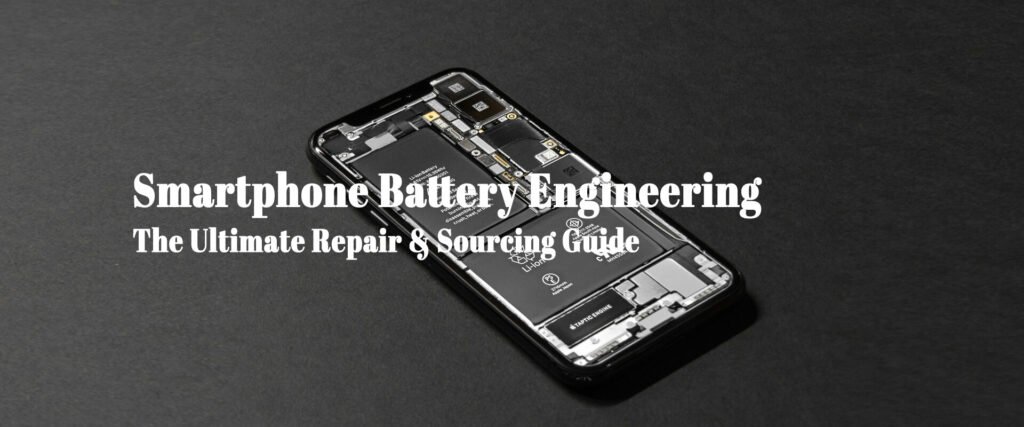
Smartphone Battery Engineering: The Ultimate Repair & Sourcing Guide
For mobile repair shop owners and bulk parts wholesalers, the repair bench is the frontline of a daily battle against hardware degradation. While cracked OLED screens represent the most visible physical damage, the true invisible war wages beneath the back cover, deep within the electrochemical core of the device. Battery replacements are the bread and butter of the mobile repair industry, yet battery quality remains the number one factor driving customer returns, warranty claims, and margin erosion.
When a customer returns a week after a battery replacement complaining of sudden shutdowns at 15%, erratic charging, or screen-lifting due to a swollen cell, the cost to the repair shop goes far beyond the price of the replacement part. It consumes technician labor, damages the shop’s reputation, and destroys profitability. Understanding why these failures occur requires moving past generic marketing labels like “High Capacity” and delving into the physics of failure, cell chemistry, and the rigorous manufacturing standards that separate premium components from budget hazards.
Chemistry Breakdown: The LCO Imperative
To understand smartphone power dynamics, we must first examine the chemistry. Unlike electric vehicles or power tools that often utilize Nickel Manganese Cobalt (NMC) or Lithium Iron Phosphate (LFP) for their thermal stability and high discharge rates, modern high-end smartphones rely almost exclusively on Lithium Cobalt Oxide (LCO).
Why LCO? The answer lies in Volumetric Energy Density (Wh/L). Smartphones are heavily space-constrained. LCO possesses a remarkably high tapped density, allowing engineers to pack an immense amount of active material into a microscopic volume. Furthermore, modern flagship devices push LCO into the High-Voltage (LiHV) territory. While traditional lithium-ion cells charge to 4.20V, modern smartphone batteries routinely charge to 4.35V, 4.40V, or even 4.45V.
This elevated voltage plateau extracts significantly more energy from the same physical footprint, but it places the cathode under extreme oxidative stress. Budget aftermarket batteries often use recycled LCO or impure cathode powders that cannot withstand these high-voltage environments. Under the stress of a 4.40V charge, these inferior materials rapidly degrade, leading to transition metal dissolution and severe capacity fade within a few dozen charge cycles.
The Anatomy of a Premium Replacement: Zero-Cycle and the BMS
A smartphone battery is not a passive bucket of energy; it is a highly intelligent subsystem. The difference between a Grade A+ replacement and a Tier-B liability often comes down to two factors: the electrochemical freshness of the cell and the sophistication of the Battery Management System (BMS).
The “Zero-Cycle” Reality
In the wholesale market, “Zero-Cycle” is a frequently abused term. A true zero-cycle battery means the cell contains chemically fresh, un-cycled active materials directly from the factory line. However, unscrupulous suppliers often take degraded, salvaged cells and simply use a reprogramming tool to flash the EEPROM on the BMS, resetting the cycle count data to zero. While the phone’s OS reads a fresh battery, the degraded internal chemistry will inevitably fail under load. True zero-cycle integrity requires a transparent, auditable upstream supply chain.
The Protection Circuit and Fuel Gauge IC
The BMS is the brain of the battery. Premium OEM-quality batteries utilize authentic Fuel Gauge ICs (often manufactured by Texas Instruments or similar top-tier foundries). These ICs use advanced impedance tracking algorithms to monitor the battery’s health, temperature, and voltage, communicating this data to the phone’s System-on-Chip (SoC) via I2C or HDQ protocols.
Budget batteries frequently use cloned or “dummy” ICs that spoof this data. When the phone’s processor demands a peak current draw (for instance, when launching the camera app or connecting to a 5G tower), a fake Fuel Gauge IC cannot accurately report the voltage drop. Furthermore, high-quality BMS boards utilize premium, low-resistance MOSFETs to control the power flow. Cheap MOSFETs generate excess heat and can fail to trigger critical over-voltage or under-voltage protection, leading to deep discharge damage or overcharge swelling.
Supply Chain Dynamics and Voltage Sag
The aftermarket mobile parts supply chain is notoriously fragmented. Navigating this landscape requires an engineering-first approach to procurement. When navigating the aftermarket supply chain, sourcing a reliable phone battery requires an understanding of manufacturing consistency.
High-consistency electrode coating and precision calendering directly reduce voltage sag under load. Voltage sag occurs when a sudden spike in current demand causes the battery’s output voltage to plummet. If a battery is manufactured with uneven electrode coating or poor tab welding, its internal resistance will be inherently high. When the user opens a demanding application, the voltage sags below the phone’s critical shut-off threshold (typically around 3.2V), causing the device to abruptly power down even if the battery indicator reads 20% or 30%. Upstream manufacturers who tightly control their slurry mixing and coating tolerances eliminate this erratic behavior.
The Physics of Failure: Internal Resistance (ESR) and “Puffing”
Equivalent Series Resistance (ESR) is arguably the most critical metric for a repair technician to understand. ESR is the internal opposition to the flow of current within the cell. It is the sum of the electronic resistance (tabs, current collectors) and ionic resistance (electrolyte, separator).
Consider the physics of Joule heating: Power(Heat)=I²R.
If a flagship smartphone draws a 3 Amp peak current, a seemingly microscopic difference in internal resistance has massive thermal consequences. A premium battery might have an ESR of 35mΩ, while a budget battery might measure 40mΩ. That 5mΩ difference might sound trivial, but under a heavy load, it generates significantly more internal heat.
Heat is the ultimate enemy of lithium-ion chemistry. Elevated temperatures accelerate the parasitic reactions between the charged electrodes and the liquid electrolyte. As the electrolyte oxidizes and breaks down, it generates hydrocarbon gases (CO2, CO, CH4). Because smartphone batteries are sealed in flexible aluminum-laminated films, these gases have nowhere to escape. The result is the dreaded “puffing” or swelling. A bloated battery exerts immense kinetic force against the chassis, lifting OLED screens, shattering back glass, and turning a simple battery repair into a costly, multi-component damage claim for the shop.
The Rise of Foldables and Niche Hardware
As the mobile industry evolves beyond the standard “glass slab,” the mechanical constraints placed on batteries are becoming exponentially more complex. Foldable smartphones, dual-screen devices, and ultra-compact gaming phones require radical power architectures.
In foldable devices, the battery capacity is often split into two separate cells, placed on either side of the hinge to balance the device’s center of gravity and manage thermal dissipation. These cells must be matched perfectly in terms of capacity and internal impedance; otherwise, one cell will age faster than the other, crippling the device. Furthermore, internal chassis designs are utilizing L-shaped, stepped, or ultra-thin cavities to accommodate larger camera modules and 5G antennas.
To maximize volumetric efficiency in these complex chassis, OEMs and top-tier aftermarket suppliers rely on a custom lipo battery architecture, where bespoke cell dimensions are engineered to fill 100% of the available spatial voids. For wholesalers and repair shops, sourcing parts for these niche devices means partnering with manufacturers capable of high-precision, custom-tooled soft-pack assembly, rather than relying on generic, off-the-shelf cell formats.
Safety Benchmarks: The Wholesale Prerequisite
For bulk parts wholesalers and high-volume repair depots, battery safety is not just a technical requirement; it is a massive liability and logistical hurdle. Importing and storing thousands of lithium-ion cells requires strict adherence to international safety benchmarks.
- UN38.3: This is a mandatory United Nations standard for the safe transportation of lithium batteries. It involves rigorous environmental, mechanical, and electrical testing, including altitude simulation, thermal cycling, vibration, shock, and external short-circuit tests. Batteries without verifiable UN38.3 certification are at high risk of customs seizure and pose a severe fire hazard during air freight.
- UL1642 / IEEE 1725: These are critical cell-level and system-level safety standards that test the battery’s resilience to crush, impact, overcharge, and forced discharge. Sourcing batteries that meet these criteria ensures that the cells have robust separators and stable chemistry that will not easily enter thermal runaway if a technician accidentally bends or punctures the cell slightly during installation.
| Feature / Metric | Grade A+ OEM Quality | Budget Tier-B Aftermarket | Engineering & Business Impact |
|---|---|---|---|
| Cycle Life (to 80% Ret.) | 500 - 800 Cycles | 150 - 300 Cycles | Determines customer satisfaction and warranty return rates over a 12-24 month period. |
| BMS Safety & MOSFETs | Dual TI/Premium ICs, Low-RDS(on) | Cloned ICs, High-Resistance | Premium BMS prevents deep-discharge bricking and inaccurate battery percentage jumps. |
| Internal Resistance (ESR) | < 40 mΩ (Highly Stable) | > 60 mΩ (Fluctuates) | High ESR causes severe voltage sag, unexpected shutdowns, and rapid heat generation. |
| Capacity Retention | True "Zero-Cycle" Chemistry | Faked EEPROM / Salvaged Cells | Budget cells experience rapid capacity cliff-drops after the first few weeks of use. |
| Total Cost of Ownership | Higher upfront, near-zero RMA | Cheap upfront, High RMA costs | Technician labor for warranty rework wipes out any initial savings on budget parts. |
Conclusion: The Procurement Checklist for Repair Shops
The mobile repair industry is shifting. Consumers are holding onto their devices longer, making battery replacements more critical than ever. For repair shop owners and wholesalers, treating batteries as a commoditized race-to-the-bottom is a failing business strategy. To protect your margins and your reputation, elevate your procurement standards.
When evaluating a new battery supplier, use this engineering checklist:
- Demand BMS Transparency: Ask what specific Fuel Gauge ICs and MOSFETs are used on the protection board. If the supplier cannot answer, they are likely sourcing generic, cloned boards.
- Request ESR Data: Ask for the typical Equivalent Series Resistance (ACIR/DCIR) batch testing data. Consistent, low ESR is the hallmark of a tightly controlled manufacturing process.
- Verify Certifications: Never import bulk shipments without verifying current, authentic UN38.3 and UL test reports.
- Understand the Chemistry: Ensure your supplier explicitly guarantees fresh, zero-cycle LCO active materials capable of withstanding the high-voltage (4.35V+) demands of modern smartphones.
By aligning your procurement strategy with the physics of battery engineering, you eliminate the invisible war under the back cover, ensuring that every device that leaves your bench stays in the customer’s hands, powering their digital lives safely and reliably.